The UNESCO heritage Sveshtari Thracian Tomb
The Sveshtari Thracian Tomb is not an obvious place.
It is not located near a big city, and nothing on the way there really prepares you for what you are about to see. But once you arrive, it quickly becomes clear that this is one of the most unusual ancient sites in Bulgaria.
A Tomb Hidden in the Landscape
The tomb dates back to the 3rd century BC and is connected to the Getae – a powerful Thracian tribe mentioned by ancient Greek authors.
It was discovered relatively recently, in 1982, inside a burial mound in the Sboryanovo area in northeastern Bulgaria. What initially seemed like just another Thracian tomb turned out to be something quite different.
Soon after its discovery, it became clear that this was a site of exceptional importance, and it was later included in the UNESCO World Heritage list.
The World of the Getae
The tomb is part of a much larger necropolis, with dozens of burial mounds spread across the landscape.
This was not just a burial ground, but the centre of a powerful Thracian community. Archaeologists have found evidence of settlements, sanctuaries and royal residences in the area, suggesting that this was an important political and religious centre.
Standing there today, it is a quiet and almost empty place – which makes it hard to imagine how significant it once was.
What Makes the Tomb Different
From the outside, the mound looks relatively simple.
The real surprise is inside.
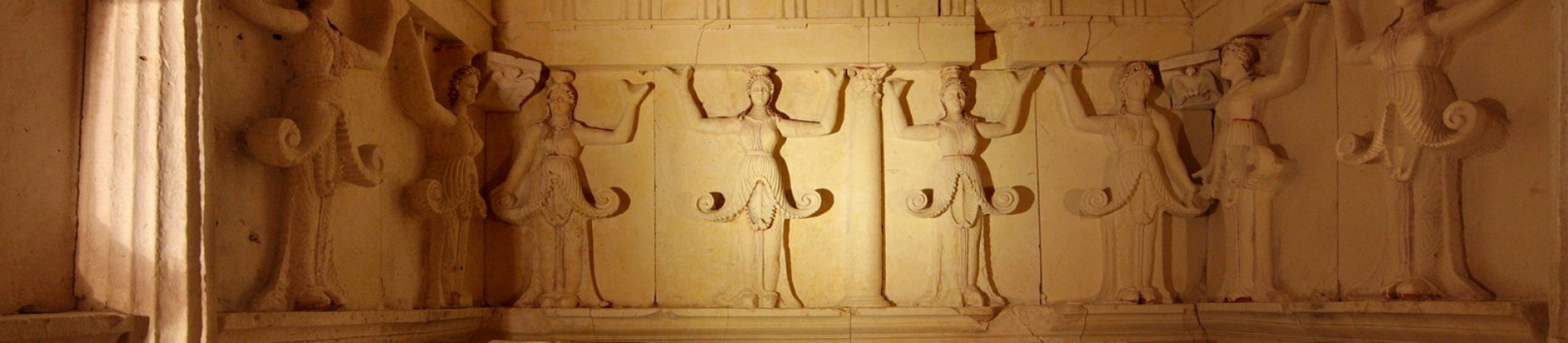
The burial chamber is small, but the decoration is unlike anything else found in Thracian tombs. Along the walls stand ten sculpted female figures, carved directly into the stone.
They are often described as caryatids, but they do not look exactly like the classical Greek ones. There is something different about them – something that feels both familiar and unusual at the same time.
The Caryatids
These figures appear to support the ceiling, but at the same time they seem almost symbolic rather than structural.
Their faces are calm, their forms are stylized, and their presence creates a very distinct atmosphere inside the chamber. It is not just decoration – it feels like part of a larger idea that is not entirely easy to interpret.
Above them, there is a painted frieze showing a ritual scene, believed to represent the transformation of the deceased ruler into a hero – an important concept in Thracian beliefs.
A Blend of Cultures
One of the most interesting aspects of the tomb is the combination of influences.
You can clearly see elements of Greek art, but they are adapted in a way that feels local and distinct. It is not a copy – it is something created within the Thracian world, using ideas from elsewhere.
This is what makes the tomb so important. It gives a rare glimpse into a culture that is still not fully understood.
Visiting Sveshtari
Today, the tomb can be visited as part of the Sboryanovo Archaeological Reserve.
Access inside is limited in order to preserve the delicate decoration, but even a short visit inside the chamber is enough to leave a strong impression.
The surrounding area is quiet, almost empty, with burial mounds scattered across the landscape. It is a place that feels distant from everything, which somehow fits the atmosphere of the site itself.
Private Tours Including the Sveshtari Tomb
The Sveshtari Thracian Tomb can be visited during my
Thracian Tombs Private Tour, which explores the most important burial monuments of the ancient Thracians across Bulgaria. The site is also included in the broader
Ancient Bulgaria Tour and in my
Private UNESCO Tour in Bulgaria, dedicated to the country’s most significant World Heritage landmarks.





 bulgariaprivateguide@gmail.com